Straight answers on process, pricing, timelines, and what makes a floor coating last. If you don't see your question here, call us — we're happy to walk you through it.
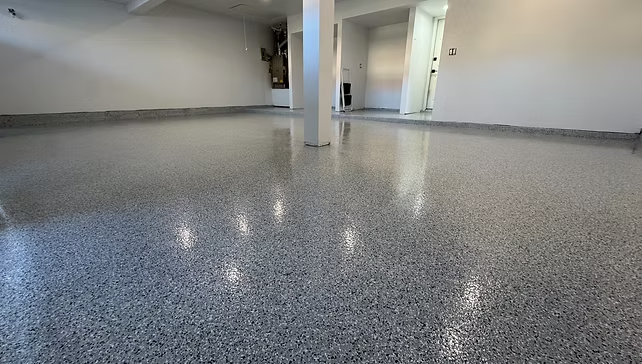
Garage floor — full flake system + polyaspartic topcoat
My process is a four-day system. After the final topcoat, I always recommend a full week of cure time.
I recommend waiting a full week after the final topcoat. The manufacturer says you can drive on it after 48 hours, but I always recommend the full week for proper cure. We've found this to deliver the absolute best, longest-lasting result.
Because dry and cured aren't the same thing. A fast turnaround usually means one of two things — a thinner, single-layer system, or a full system rushed before the resin has reached its real strength. The floor looks finished while the chemistry is still catching up, and that's where hot tire pickup, delamination, and early peeling come from. Our four-day install and one-week cure window isn't slower work; it's the schedule the materials actually call for. We'd rather ask for a few extra days up front than come back to a floor that failed in year two.
Yes — every HP Epoxy Coatings installation comes with a 5-year written warranty covering peeling, delamination, and defects in materials or workmanship under normal use conditions.
Epoxy is the foundation — it bonds tightly to the concrete and provides a hard, chemical-resistant base. Polyaspartic is a topcoat applied over the epoxy that adds UV stability (won't yellow in sunlight), scratch resistance, and a long-lasting gloss. We use both: epoxy for strength, polyaspartic to protect it for the long term.
We use diamond grinding to mechanically profile the concrete surface. This opens up the pores, removes existing sealers or contaminants, and creates the mechanical bond needed for a coating that won't peel. Proper prep is the most critical step — it's what separates a professional install from a DIY kit that fails in two years.
Yes. Minor cracks and spalling are patched and filled as part of our prep process. Structural cracks — those that are actively moving or growing — require evaluation, but most cosmetic cracks in typical garage floors are fully treatable.
A broadcast flake system is not slippery — the texture of the flakes provides natural grip underfoot. We can also add an anti-slip aggregate to any finish. A smooth, bare epoxy surface can be slick when wet, which is why we recommend a flake system for garages, patios, and outdoor spaces.
Pricing depends on the floor size, current condition, and the system chosen. We provide free on-site estimates so there are no surprises. Call (805) 896-6803 or submit the quote form on our website to get a number specific to your project.
We serve Thousand Oaks, Westlake Village, Newbury Park, Camarillo, Ventura, and greater Ventura County and the western Los Angeles area. Not sure if we cover your city? Give us a call and we'll let you know.
Epoxy and polyaspartic coatings are very low maintenance. Sweep or blow out dust and debris regularly. For deeper cleaning, a mop with warm water and a mild pH-neutral cleaner is all you need. Avoid harsh acids, bleach, or abrasive scrubbers. The coating is resistant to oil, gas, brake fluid, and most household chemicals.
Yes. HP Epoxy Coatings is a licensed California contractor (CSLB #1155084), fully bonded and insured. You can verify our license at the California State License Board website.
We're easy to reach. Call, email, or request a free on-site estimate.